
18,30 €
incl. 19% VAT
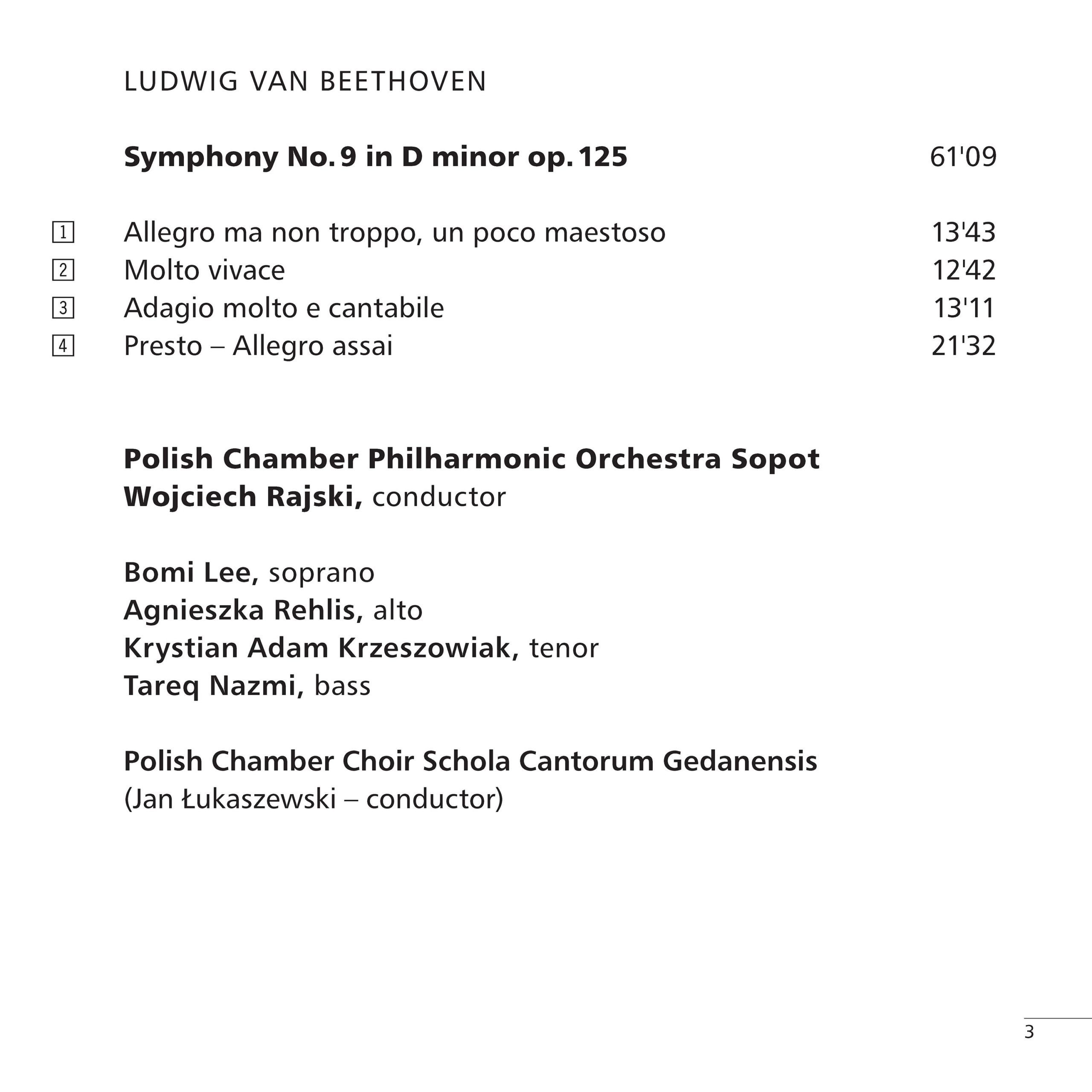
Ludwig van Beethoven: Symphony No. 9 in D minor op. 125.
Polish Chamber Philharmonic Orchestra, Wojciech Rajski
- TACET Real Surround Sound
- Total playing time (mmm:ss): 61:09
- 5.1 standard channel order: front left – front right – center – subwoofer (not used) – surround left – surround right
- 96 kHz, 24 bit. Format: Flac (lossless)
- Download as zip file. Booklet (English, German, French) and cover images included
- Size: 2.40 GB
- Barcode: 4009850021926
Description
“All men will be brothers” – wouldn’t that be something? Did he (Friedrich Schiller) actually mean us? There is a disconcertingly wide discrepancy between the hope expressed in the 9th Symphony and geopolitical reality.
“All men will be brothers”. An illusion? A utopia? – For once we should just indulge this thought and be inspired
by the way that Wojciech Rajski makes the idea a reality in such a carefree and contagious manner with his
Polish Chamber Philharmonic, the Schola Cantorum Gedanensis choir, soloists Bomi Lee (Korea), Agnieszka
Rehlis, Krystian Adam Krzeszowiak (both Poland) and Tareq Nazmi (Egypt) and indeed all of us here in
Germany. This is due in no small measure to the fact that Wojciech Rajski follows the instructions in the score
precisely. Of course, the Götterfunke (spark of divinity) ignites particularly well in TACET Real Surround Sound!
Rémy Franck wrote of the stereo version in Pizzicato (www.pizzicato.lu): “… there is no false solemnity here,
just happy, untroubled upbeat joy … ”
Audiosample (mp3, stereo)
Booklet
Reviews
You must be logged in to post a review.


klassik.com –
–> original review
Beethoven’s Ninth in so-called ‘real surround sound’: an exciting, sonically appealing alternative.
Purchase not verified. Find out more
Fanfare-Magazin –
–> original review
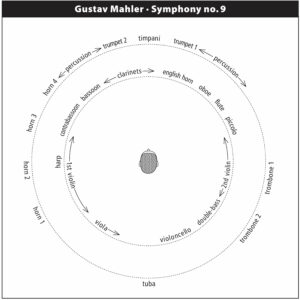
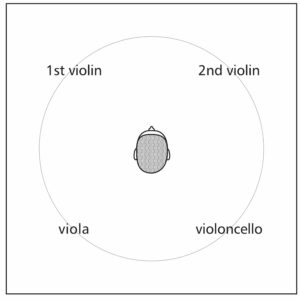
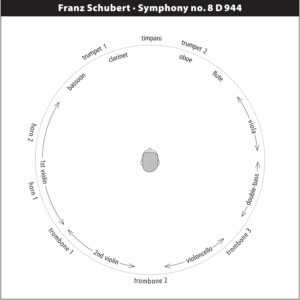
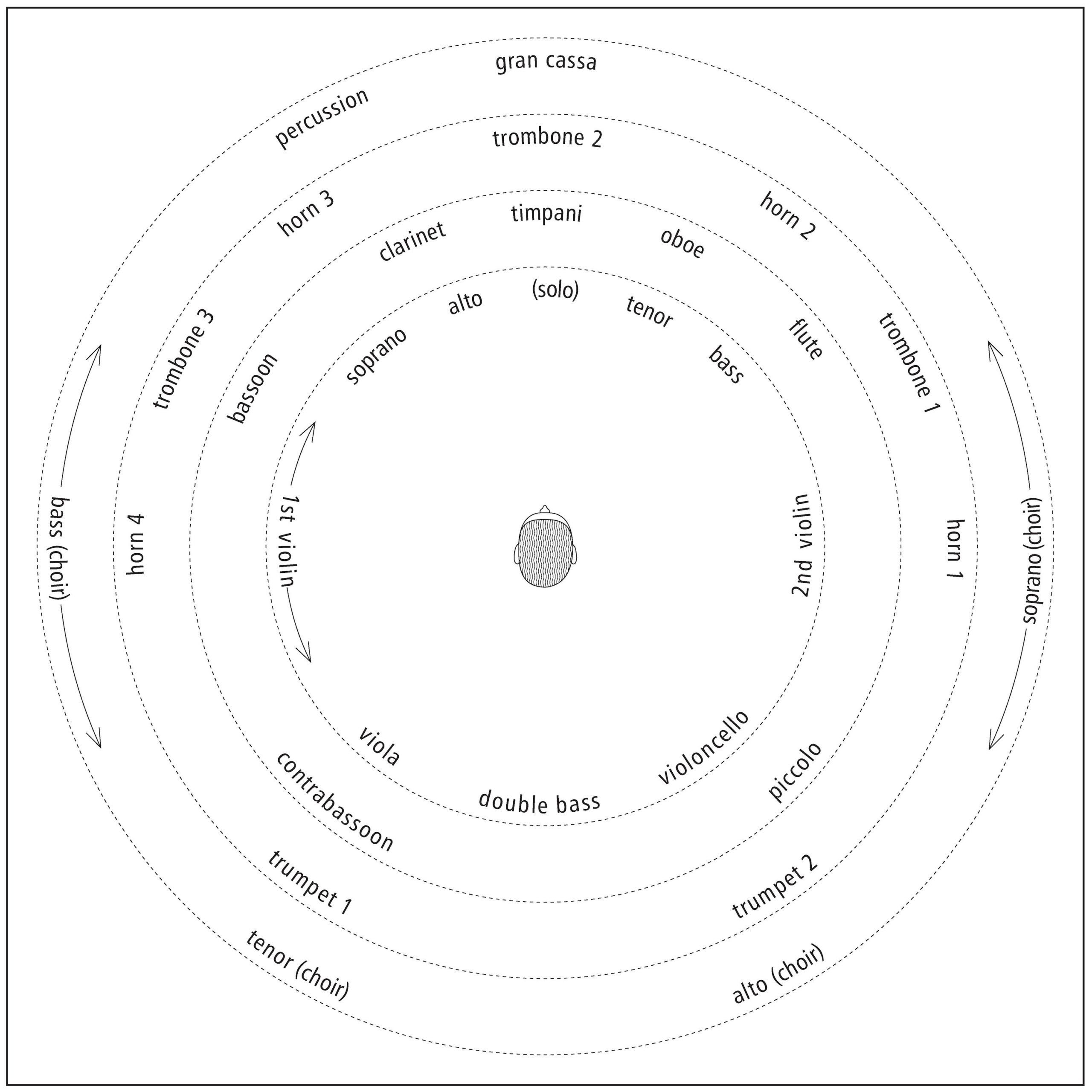
Tacet, founded by Tonmeister AndreasSpreer, is a company with strong audio commitments—strong and highlypersonal, as is clear on this striking new release. On the one hand, Spreer has a continuing devotion to certain “old” technologies, inparticular tube equipment. On the other hand, he is not above radicalintervention in post-production. Thus, this Beethoven Ninth was recorded using tube microphones and amplifiers and with the orchestra in a moreor less normal seating configuration. But Tacet set down 32 tracks for the orchestral movements, 40 for the finale—and after the sessions were finished, the instruments were virtually relocated so that on the SACD’s multi-channel tracks we find ourselves in the middle of an unconventionally arranged circular ensemble. First violins, choralbasses, and the fourth horn flank us on the left; second violins, choralsopranos, and the first horn flank us on the right; violas, doublebasses, cellos, trumpets, tenors, and altos—as well as contrabassoon andpiccolo—are behind us; and the rest of the instruments and the vocalsoloists are spread out before us.
Whatever else you can say, this doesn’t make you feel like you’re at a concert—not only because the sounds come from unexpected directions, but also because, in the radical remixing, any sense of the hall is lost. Still, the engineering has two distinct advantages. First, the timbral quality of the instruments is exceptionally life-like: They sound like the real thing, even if they seem to be in an unnatural environment. Second, and perhaps more important, the wide separation of the instruments (the woodwinds are spread across the whole stage, rather than concentrated in two rows, for instance) gives the back and forth instrumental play exceptional prominence. Rarely has Beethoven’s inner billiards-player come across so clearly.
With an epic interpretation (the extreme case being Bernstein’s at the Berlin Wall), I doubt this kind of sound reproduction—which emphasizes space rather than mass—would serve. Fortunately, Rajski offers precisely the kind of springy performance that makes the most of the engineering. Tempos are exceptionally fleet—but the orchestra is small, rhythms are sharp, and sonorities are light, so the performance rarely sounds rushed, even in the finale, which dashes by in well under 22 minutes. Rajski also keeps the larger gestures in proportion. The outburst that opens the last movement stings more than it crushes; and the closing pages are uplifting but far from heaven-storming.
Those looking for an Important Ninth, one that reflects the work’s monumental status in our culture, may find it all too insubstantial, even flimsy—especially the slow movement, which could arguably be more rapt at ist center. But if you can conceive of the Ninth as a final kick to Classicism, rather than a proclamation of the coming Romantic order, you should find this performance rewarding. The orchestra plays with zest and the singing certainly never gets in the way. Recommended for the adventurous.
© 2017 Fanfare
Peter J. Rabinowitz
Purchase not verified. Find out more
Classical CD Review –
–> original review
Beethoven’s symphonies have fared well on SACD, particularly the remarkable Leipzig Gewandhaus/Kurt Masur set recorded 1974 -1976 in quad and now released by Pentatone. There are a number of other recordings of various symphonies (many mentioned on this site) , but none of them have the plus of Tacet;s “true surround sound.” This site has praised previous issues in the label’s Beethoven symphony cycle with the Polish Chamber Philharmonic Orchestra directed by Wojciech Rajski. These are vital, dynamic readings, beautifully played and recorded in spectacular”true surround sound.”
Now the cycle is completed with the mighty Symphony No. 9 and it does not disappoint. It is a fine, energetic performance with an outstanding quartet of soloists. Hearing it in 5.1 audio is a thrilling experience. A diagram in the booklet shows location of all performers. The chorus is spread around the hall, with male voices in the rear. The four soloists are nicely spaced, women front left, men, front right. Low strings are very pronounced, and there always is a fine sense of being in a great concert hall. Surprisingly, cymbals, used only in the finale, are virtually inaudible. However, without question this is a major issue for those interested in multi-channel audio. This has been issued as a separate SACD, but if you don’t have the other eight, surely the way to get it is on the Blu Ray set that contains all nine symphonies. If you already own the others, get the single disk Ninth. If you have a true interest in surround sound, you should not miss these unique recordings. (…)
Robert Benson
Purchase not verified. Find out more
Audiophile Audition –
–> original review
(…) Let’s start with the more unique approach. It has been recorded by Tacet in Germany, and as is their custom of late, it’s recorded in what they call Real Surround Sound. This is not the usual method of instruments up front with ambiance to the rear. In this 9th, performed by the Polish Chamber Orchestra conducted by Wojciech Rajski, we are literally surrounded by the orchestra and chorus. First violins centered between the left front and rear speaker. Piccolo between the right front and right rear, soloists spread up front, while the chorus is in a semicircle at the rear.
It appears to be a gimmick at first glance, but in fact I felt it was the audio equivalent of having the conductor score in front of you. It’s easier to follow musical threads, and I got a greater appreciation for the majesty of the composition listening in full surround. It was disconcerting at first, but after awhile, I found it a musically satisfying experience. The performance is fine, and the 9th is played at a brisk pace. The bass is prodigious when it’s called for, although every so often in the fourth movement I heard some deep thumps, perhaps someone walking where they should not have been, or a heating/cooling system kicking in.
Einige werden diese Surround-Mischung nicht mögen, und die SACD bietet auch eine hochauflösende Stereomischung sowie die übliche CD-Schicht, aber ich denke, diese Disc ist es wert, in diesem umhüllenden Surround-Format gehört zu werden, und ich bin froh, sie rezensieren zu dürfen. Gegen alle Erwartungen funktioniert dieses ‚Gimmick‘ tatsächlich musikalisch und emotional.
(…) The Tacet disc offers 5.1 surround, high resolution stereo, the CD layer and the non-traditional 2+2+2 format which requires speakers over your head. I’m not equipped for that kind of playback, so listened to the 5.1 and stereo tracks. The Tacet recording reminds me of an early quad vinyl disc and reel-reel recording from Columbia of the Bartok Concerto for Orchestra with Boulez. Listeners were surrounded by the music. Oddly, with the advent of SACD, Columbia released that performance with the orchestra in the front speakers, just ambiance behind.
Tacet is actively engaged in exploring ways to uniquely deliver music. They have a large catalog of these True Surround Sound discs on SACD and Blu-ray, and they are offering vinyl discs of some as well.
Neither disc is the zenith of Beethoven performances from my standpoint. I still love the Von Karajan 9th from his 1962-63 cycle of Beethoven recordings [also available on a DVD at 4:3 ratio, with probably only mono or stereo audio…Ed.], and I’m enamored with Gunter Wand’s intense version from 1986 on the Sound Dimension label. Still, the Rajski and the Blunier are worth having in your library and the Rajski is unique enough for me to recommend it enthusiastically.
Mel Martin
Purchase not verified. Find out more
Pizzicato –
–> original review
Wojciech Rajski’s Beethoven cycle is characterized by a lot of drive in the outer movements and by flourishing brass colors in the slow movements. The pulsating, richly accented, transparent, and consistently tension-filled musical performance leads to an extraordinary richness of sound.
When the recordings were released on CD in stereo, pizzicato published this review. Now, Tacet releases the 9th Symphony on SACD and the entire cycle on Blu-ray in Tacet’s ‘Real Surround Sound.’ Audiophile readers will be richly rewarded for their patience because the Beethoven symphonies, recorded without transistors, are something truly exceptional in “Surround Sound,” and this is especially true for the Ninth, where the HD sound and surround mic-ing guarantee a magnificent listening experience.
Remy Franck
Purchase not verified. Find out more
hraudio.net –
–> original review
This release marks the completion of the Beethoven Symphony cycle from the Polish Chamber Philharmonic Orchestra and their founder and director Wojciech Rajski – a project that has taken ten years to reach fruition. As many visitors (and contributors) to this site and to SA-CD.net will be aware, Tacet’s absolute commitment to recording in surround sound in a manner that places the listener at the centre of the orchestra makes Rajski’s cycle unique even amongst the vast number of alternative Beethoven symphony recordings available on disc.
At the forefront of Andreas Spreer’s recording philosophy is the desire to make full use of the whole acoustic space and explore the possibilities that current technology offers to enhance the overall musical experience for the home listener. This means going further than merely attempting to create the illusion of a normal concert hall and, controversial though this may seem, it really does add a new dimension to one’s appreciation of even the most familiar music.
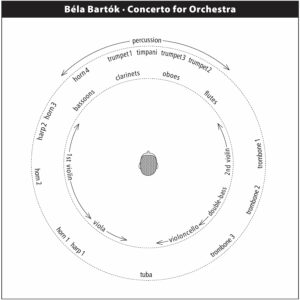
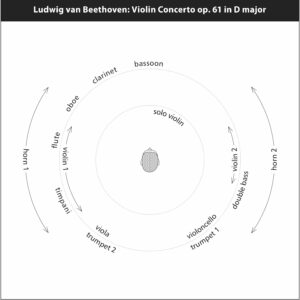
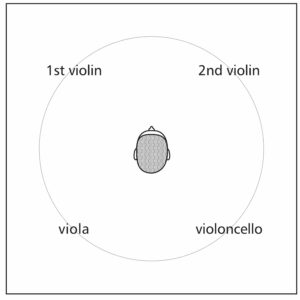
As with all of Tacet’s ‘Real Surround Sound’ recordings the liner notes provide detailed information including a diagram of the positions of the musicians with respect to the listener. This helpfully aids spatial identification when adjusting one’s surround set-up for optimum results. Tacet recommends that all the speakers are set to the same volume level, which should not be too high, and that the use of filters should be avoided. Adjustments completed, one can sit back and enjoy an enthralling and often jaw-dropping sonic experience.
In view of the larger forces involved – orchestra, soloists and chorus – the recording of the 9th Symphony did not take place in the venue used for the earlier eight symphonies (the “Stella Maria” Church in Sopot); instead St. John’s Church in the middle of the old town of Gdansk was chosen and, from the photographs in the liner notes, this church with its high vaulted ceiling would seem to be a well chosen location. I did find, however, that the considerable reverberation period of the building did cause some blurring of the chorus in the finale though it was not a problem in the instrumental movements.
Ten years ago Rajski’s account of this Symphony using a chamber orchestra, small chorus and playing with modern instruments in a generally period or ‘authentic’ style would have stood out not just for its unusual aural perspective but for its refreshingly straightforward and unfussy approach. Now, however, one misses the greater insights and nuances that, for example, Paavo Jarvi and his crack Deutsche Kammerphilharmonie, Bremen bring to the work Beethoven: Symphony No. 9 – Paavo Järvi. The Polish Chamber Philharmonic Orchestra though do not disappoint and perform most creditably throughout. Rajski is also fortunate to have an excellent line up of soloists for the choral finale, especially the splendid bass Tareq Nazmi whose firm delivery and impeccable diction are outstanding. The Polish Chamber Choir Schola Cantorum Gedanensis, after two surprisingly halfhearted cries of ‘Freude’ quickly come alive and sing with full-throated enthusiasm throughout the remainder of the finale.
Those who have invested in the four earlier SACD releases in this series will certainly wish to add this one to their collection. It is worth noting, however, that newcomers can now acquire the whole cycle as a set of three Blu-ray discs (three symphonies per disc) Beethoven: 9 Symphonies – Rajski. a most tempting prospect.
Copyright © 2016 Graham Williams und HRAudio.net
Purchase not verified. Find out more
Journal Frankfurt Nr. 14/15 –
Beethoven’s work once initiated vocal symphonies. The Polish Chamber Philharmonic Orchestra presents an emotional performance, (…).
(…) However, the impeccable sound of TACET Real Surround Sound turns listening into a true delight.
hen
Purchase not verified. Find out more