
17,10 €
incl. 19% VAT
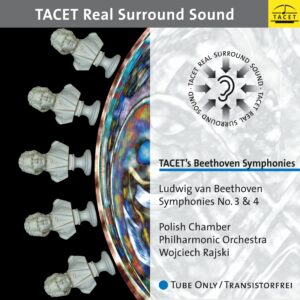
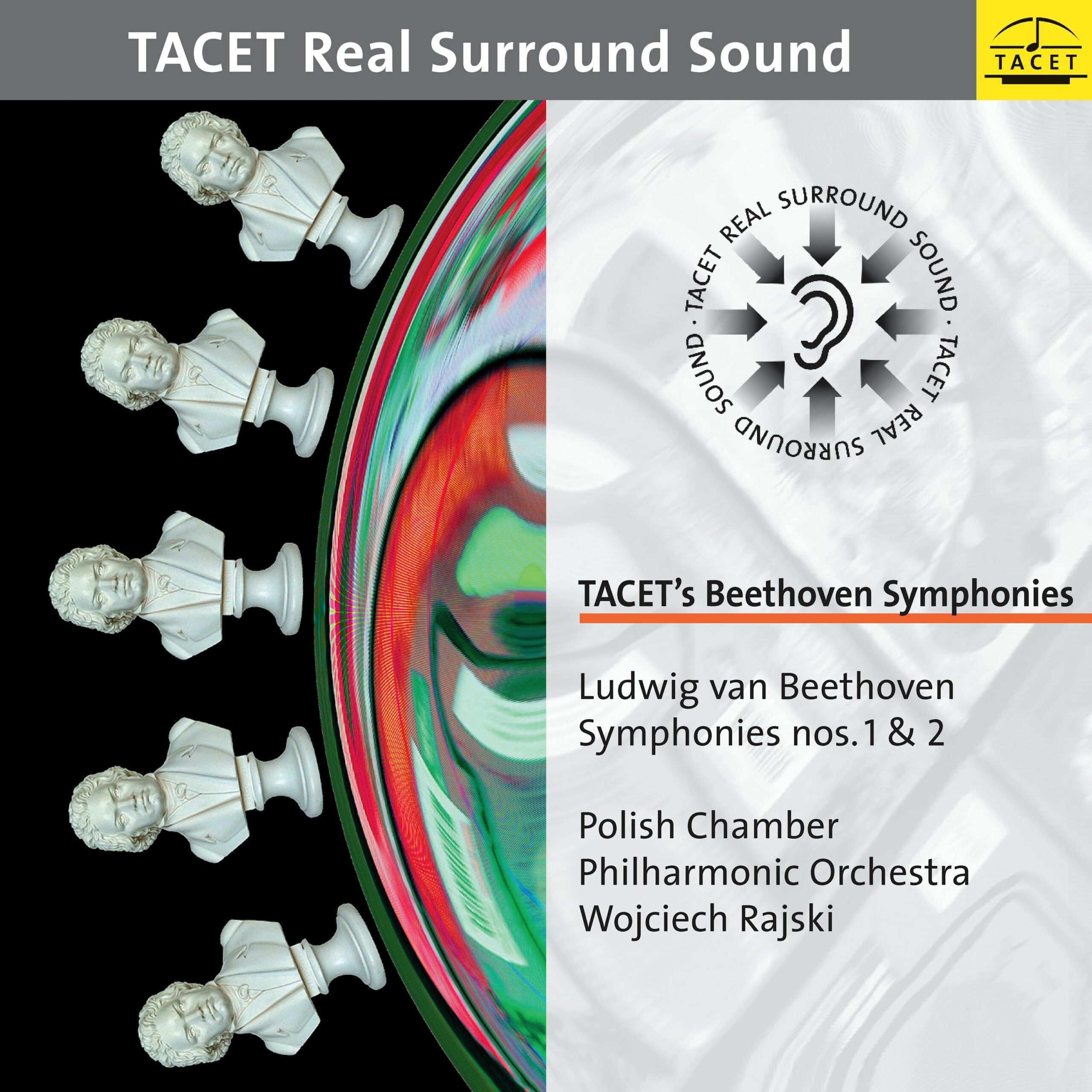
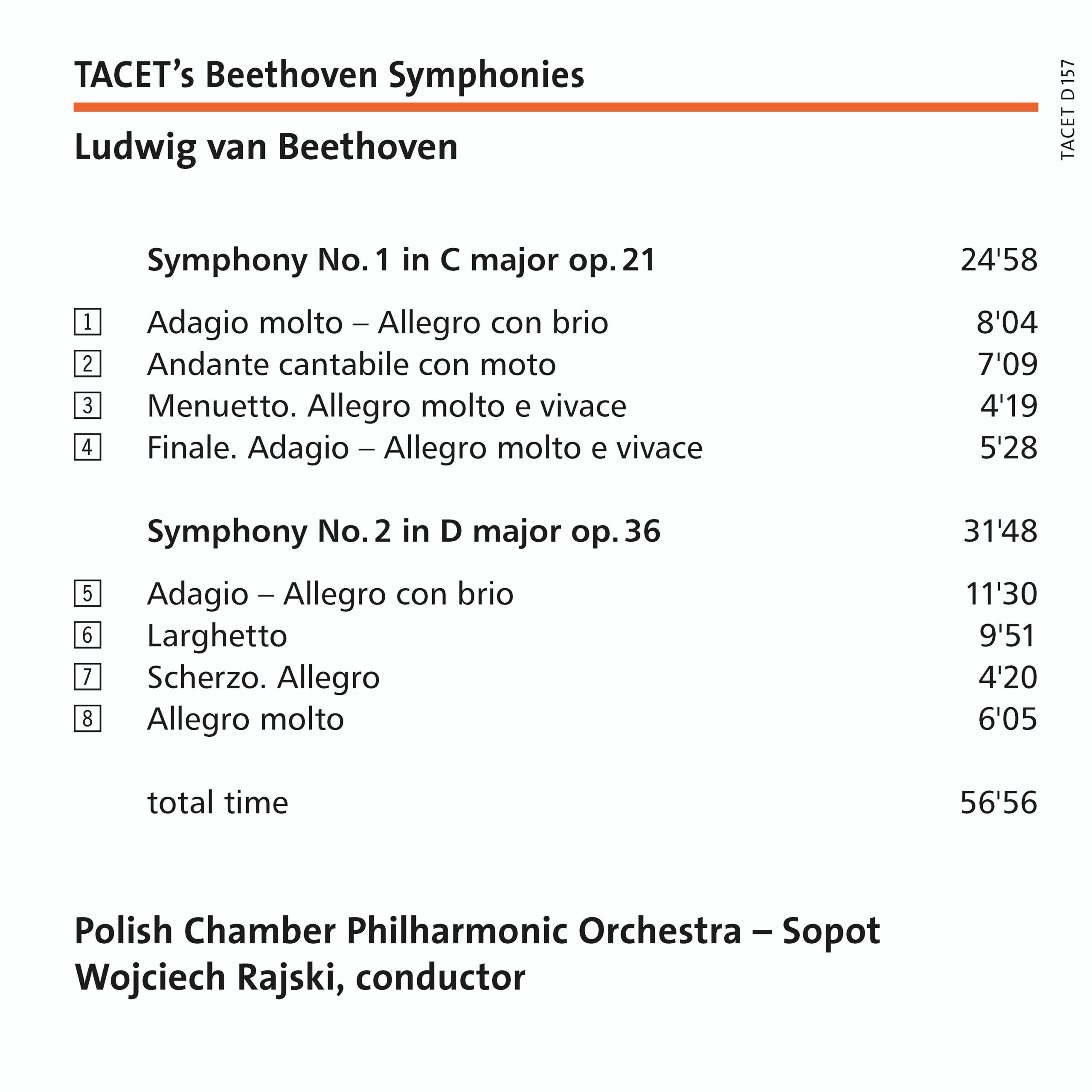
Ludwig van Beethoven: Symphonies Nos. 1 & 2
Polish Chamber Philharmonic Orchestra, Wojciech Rajski
- TACET Real Surround Sound
- Total playing time (mmm:ss): 56:56
- 5.1 standard channel order: front left – front right – center (not used) – subwoofer (not used) – surround left – surround right
- 96 kHz, 24 bit. Format: Flac (lossless)
- Download as zip file. Booklet (English, German, French) and cover images included
- Size: 1.73 GB
- Barcode: 4009850015727
Description
I have heard these two works (and also by the same performers the 7th and 8th Symphonies) many times both live in different halls with different orchestras as well as many recordings However, I have to confess I was never satisfied by those performances either at the artistic level (both live and recorded) or at the aural level when recorded. Artistically they were never right, mostly because of extraneous changes to the original instrumentation and orchestration and when recorded, because of the invariably banal sound. Happily, I can say here and now that this SACD in either its Pure Tube Stereo or Real Surround Sound version as created by Tacet, has finally moved me to think of it as my long-sought “reference” CD both artistically and aurally. Audiophile Audition
Audiosample (mp3, stereo)
Booklet
Reviews
You must be logged in to post a review.


Audiophile Audition –
Beethoven completed his first two symphonies in 1800 and 1802 respectively. Although they both look backwards to the era of Haydn and Mozart, there is much in their musical language that offers a glimpse of what is to come. The scale of both symphonies is larger than previous works in the genre. Their expressiveness and emotional content seems broader and more personal than earlier symphonies. And Beethoven’s compositional technique is more advanced and daring than either of his illustrious predecessors. It is hardly surprising that audiences were initially puzzled by what they heard.
The Symphony No.1 in C Major Op.21 is given a fleet performance by the Polish Chamber Philharmonic. Although they perform on modern instruments this orchestra has absorbed the lessons of the historically informed performance movement. Tempos are brisk, textures are relatively light and string vibrato is minimal. The orchestra emphasizes Beethoven’s rustic qualities. The symphony unfolds with a powerful forward thrust that grips the listener at the start and proceeds with steely inevitability until the final notes. If you like your Beethoven played with dancelike abandon then this performance is for you.
The Symphony No. 2 in D Major Op.36 is one of Beethoven’s most paradoxical works. Composed while he was in the depths of despair as he realized that he was losing his hearing, the symphony contains not a hint of emotional turmoil. It is a serene and confident work whose propulsive rhythms proclaim the composer’s love of nature and the rusticity of the countryside. Beethoven seems to be searching for new means of expression in this powerful symphony. The Polish Chamber Philharmonic emphasize the symphony’s blithe expressiveness, playing with a velocity that occasionally dilutes the works more profound moments. We should never forget that the D Major is the precursor to the mighty Eroica Symphony. It contains the germ of that great work’s artistic brilliance and should not be played as if it were middle-period Haydn.
Tacet’s engineers have once again created a fascinating soundstage whose immediacy and presence highlights all of the sonic beauty of these two symphonies. Using Tacet’s “Real Surround Sound” the music comes from all around you as if you are placed into the center of the orchestra. With horns coming from in front of you and trumpets from behind, loud passages have a visceral impact. It’s a thrilling experience that matches Beethoven’s robust musical style.
Mike Birman
Purchase not verified. Find out more
Klassik heute –
I still remember these Beethoven recordings with the more than competent chamber orchestra from Sopot, Poland, from Tacet CD S 157. Back then, offered as a “conventional” compact disc—flawless in sound and production, and quite impressive in terms of musical presentation—I do not recall being particularly overwhelmed by Rajski, his Beethoven interpretations, or the chamber philharmonic. Now there is the opportunity to correct this impression, which may have been due, at least in part, to professional inattention. The new edition of the two symphonies in “DVD Audio – Tacet Real Surround Sound” proved very helpful in this regard! This technology truly opens up new acoustic spaces—and, with the proper home equipment, it casts the interpretive performance in a new light. Everything now sounds more airy, more articulated, explored in greater detail at the brisk tempos, nobler, and richer in overall impression, although I must admit that under these circumstances the wind instruments seem slightly favored.
In keeping with Tacet’s aesthetic, the listener is placed right in the midst of the philharmonic action—a situation that, of course, does not correspond to the seat of a concertgoer. Yet it remains fascinating how Beethoven’s themes and their artful, at times provocative, developments unfold around the attentive listener, gaining both transparency and a healthy fullness. Occasionally, however, the recording technique reaches its limits in terms of spatial definition—especially when Rajski and his Sopot orchestra push the chamber-orchestral sound to the extreme in the final movements. A touch more restraint in tempo would significantly enhance the effect in terms of brilliance, swirling intensity, and precision of detail (particularly in the fast flourishes of the upper strings!). Overall, however, this is a highly convincing, sonically— as described—exquisite performance, which, in my listening view, deserves a front-ranking position among the many competing recordings.
Peter Cossé
Purchase not verified. Find out more
Audiophile Audition –
This SACD has finally moved me to think of it as my long-sought reference disc of Nos. 1 & 2
Beethoven′s First and Second Symphonies, together with their roughly contemporaries in time, the First and Second Piano Concertos, marked the arrival of a new voice to the concert halls of Vienna and by extension the world at large. The First was premiered on April 2, 1800 and the Second two years later on April 5, 1802. These two symphonies certainly made demands beyond the audience′s willingness to follow and accept what evidently was the outset of a new and provocative symphonic form. These two symphonies provocatively traveled henceforth to this date well beyond the “beautiful – elegant – aristocratic” compositions of Mozart, Haydn and the like.
I have heard these two works (and also by the same performers the 7th and 8th Symphonies) many times both live in different halls with different orchestras as well as many recordings However, I have to confess I was never satisfied by those performances either at the artistic level (both live and recorded) or at the aural level when recorded. Artistically they were never right, mostly because of extraneous changes to the original instrumentation and orchestration and when recorded, because of the invariably banal sound.
Happily, I can say here and now that this SACD in either ist Pure Tube Stereo or Real Surround Sound version as created by Tacet, has finally moved me to think of it as my long-sought “reference” CD both artistically and aurally.
The Polish Chamber Philharmonic Orchestra conducted by Wojciech Rajski faithfully conveys exquisitely-crafted performances captured by Tacet′s sound recording techniques, giving full body to two works scored for small orchestra albeit still keeping the instrumental doubling in the woodwinds (oboes – flutes – clarinets – bassoons) and the brasses (trumpets – horns) and reduced numbers in the string choir.
In this SACD, Tacet gracefully captures all the nuances as intended by Beethoven whether we listen to it as a Pure Stereo “Tube Only” or as a 3/2-channel Real Surround Sound. Each of these options sounds different from each other not to a detriment but as a new and different aural experience from the psycho-acoustical point of view. I certainly was thrilled to hear these works in either format, each form adding a new perspective and aural dimension.
My impression was that once I found the correct configuration for the front speakers for the Pure Stereo version and also the correct one for the 3/2 version the sound emanating from the speakers sounded as expected. The stereo version (speakers in front 10 ft. Apart) offered a full-bodied sound with perfect instrumental imaging; nothing flat or overly brilliant here. The 3/2 was also full-bodied and instrumental imaging was heightened by intelligent mike placing. All in all marvelous sounds in either version. Notable passages to listen given the two sound options with their respective characteristics and acoustic nuances, as follows:
First Symphony:
On the First Symphony, First Movement, Adagio molto – Allegro con brio: At 1:50 the beautifully captured contrast between the main and the subordinate themes in an exquisitely crafted little fragment which moves in quick succession from the oboe on the left to the flute on the right to the first violins on the left as the building block to an skillfully weighted “tension” and “release” when it reaches the finale.
On the Second Movement, Andante cantabile con moto: At the end of the extended motive with the delicate pianissimo of the timpani on the left-center against the flute (on the right), against the first violin′s triplets on the left at 1:28.
On the Fourth Movement, Finale – Adagio, allegro molto e vivace: The finale begins at :30 with the beautiful sounds of a single scale creeping upwards slowly through the first violins on the left reaching one note further with each repetition and in the end, with little patience, becoming a dance like theme which extends itself to the end.
Second Symphony:
On the Second Symphony, Second Movement. Larghetto: The beginning a broadly flowing melody for the massed string choir which is immediately and delicately echoed by the woodwinds at 0:18.
On the Third Movement. Scherzo – Allegro: The middle section (or trio) starts as a faint delicate 1700′s trio for the winds only to burst in wild, unpredictable blast by the full orchestra at 1:40.
On the Fourth Movement. Allegro molto: The first two and last two notes of the explosive beginning serve as thematic fragments to be tossed back and forth in an antiphonal fashion between the instruments of the orchestra at 0:21 marking the start of a tension- loaded musical structure (in rondo-sonata form) all the way to the finale.
Finally, I think of these performances as two beautifully-crafted period interpretations with modern instruments and a much needed addition to the already large Beethoven discography. Beautiful performances and glorious sound, definitely a reference CD/SACD!
John Nemaric
Purchase not verified. Find out more
Le monde de la musique –
The publisher boasts of offering the first complete (ongoing) edition of Beethoven’s symphonies in “Surround 5.1.” Let us simply note the quality of the recording in standard stereo, which is simultaneously rich, natural, and detailed. As for the interpretations of these early attempts, which bear the shadow of Haydn, the conductor and the ensemble he founded a quarter of a century ago need not feel ashamed in comparison to more prestigious artists. These are readings full of vitality yet nuanced, spontaneous yet precise. While they do not constitute new reference versions, these performances can be recommended without hesitation. A very pleasant surprise.
John Tyler Tuttle
____________________________________
Original Review in French language:
L’éditeur se vante de proposer la première intégrale (en cours) des symphonies de Beethoven en «Surround 5.1» Bornons-nous a constater déjà la qualité de la prise de son en simple stéréophonie, son qui est a la fois riche, naturel et détaille. Quant aux interprétations de ces premiers essais sur lesquels plane l′ombre de Haydn, le chef et l′ensemble qu′il a fonde il y a un quart de siècle n′ont pas a rougir face à des artistes plus prestigieux. Ce sont des lectures pleines d’entrain mais nuancées spontanées mais précises. Sans être question de nouvelles références, ces versions peuvent se recommander sans problème. Une très bonne surprise.
John Tyler Tuttle
Purchase not verified. Find out more
sa-cd.net –
–> original review
Published here with kind permission of sa-cd.net and John Broggio.
This instalment in Tacet’s Beethoven cycle is almost as enjoyable as their previous release: Beethoven: Symphonies Nos. 7 & 8 – Rajski
Using small forces, the early Beethoven symphonies are presented with a youthful enthusiasm rather than a revolutionary zeal as evinced by Haitink in his LSO Live cycle. This is perhaps largely due to the chamber sized orchestra rather than the full force of the LSO (even in the early symphonies). Such an approach pays dividends here by showing the link with Mozart and Haydn that Beethoven was at the same time imitating yet attempting to usurp in terms of musical language.
Allegro’s are fleet, slow movements move with flowing grace and the first symphony’s Menuetto is (to someone with two left feet) impossibly fast for the titular purpose! The Scherzo is not comical in the way that Haydn would have recognised but there are some serious “jokes” which are given the full effect because of the divided violins (see below). The dynamics are all there but not given a Romantic heft in the way that other accounts can apply – many would think this appropriate given the revolution of the Eroica has yet to be penned but there may be a few who feel a little short-changed.
In general, the Polish Chamber Philharmonic Orchestra (Sopot) are well drilled under Wojciech Rajski but there are a couple of notorious passages in the Second symphony where the violins in particular are not allowed to stand the close scrutiny that is afforded to other orchestral sections or passages; it is hard to tell if this is the engineers decision, Rajski’s decision, the sections decisions or a combination of all three. The oboes in the second movement of the Second symphony sound as though they are tuned to a very slightly different A than the rest of the orchestra – was a different take used? Not sure, but another one should have been! These moments are few in number but I worry that they would jar increasingly upon repeated listening and those looking for a fleet-of-foot and very enjoyable First symphony need not worry.
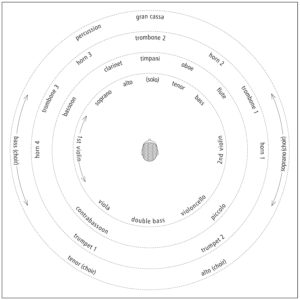
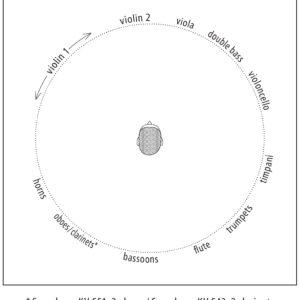
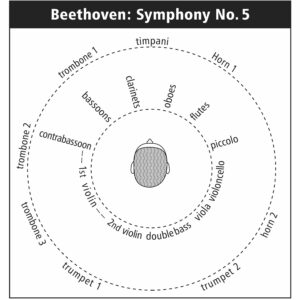
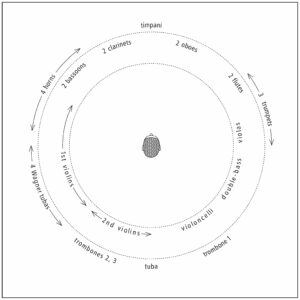
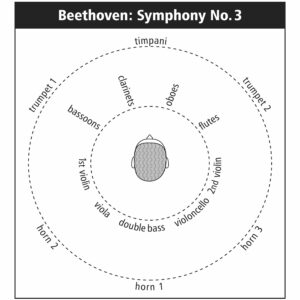
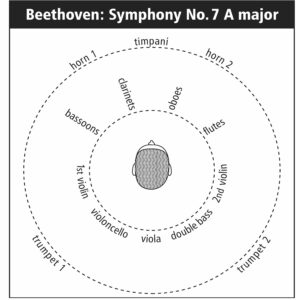
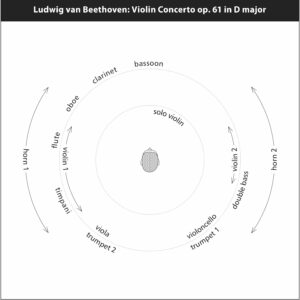
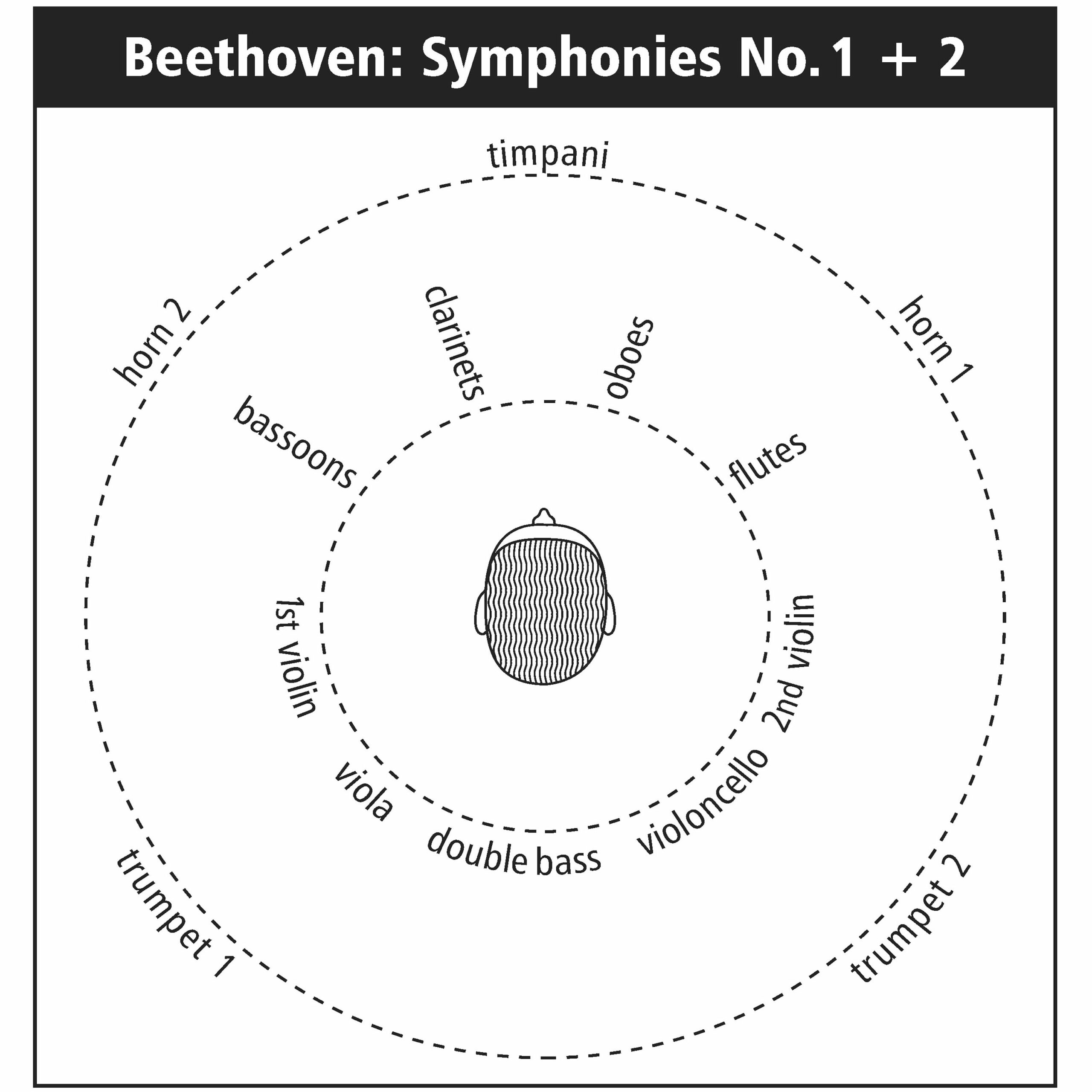
In both these performances, the following recording layout in MCH is adopted;
Outer circle: Horn 1 (FR), Timpani (Centre), Horn 2 (FL), Trumpet 1 (RL), Trumpet 2 (RR)
Inner circle: Bassoons, Clarinets, Oboes, Flutes (front from left to right) and 1st violins, Violas, Basses, Cellos, 2nd violins (rear left to right)
This places the listener in the thick of the action and it is quite thrilling. So many details that normally have to be sought out by referring to the score, leap off the page and into the minds eyes. Sometimes the whirl of the finales is almost motion-sickness inducing! Greatly enjoyable and a genuinely stimulating approach that all who are interested in Beethoven should try and hear.
As before, a careful set-up of ones equipment is needed or the marvellous effects are quickly lost and submerged into a mire of echoes.
Recommended for the first symphony without hesitation; the second symphony carries a minor health warning but is largely enjoyable and I will be returning to this for inspiration (but it will not displace Haitink or similar accounts from my affections).
John Broggio
Purchase not verified. Find out more
sa-cd.net –
–> original review
This the second volume in a series of the complete Beethoven symphonies being undertaken by the independent, Stuttgart-based company TACET. I found the first disc (of Symphonies 7 and 8) revelatory (see review at Beethoven: Symphonies Nos. 7 & 8 – Rajski), and this new coupling is no less exciting.
The works are smaller in scale and scope, of course, but the performances of conductor Wojciech Rajski and his excellent Polish Chamber Philharmonic Orchestra are no less lean, supple and punchy than in Volume 1. Rajski has the gift, surprisingly rare in Beethoven, of finding the “tempo giusto”, injecting the music with plenty of youthful vigour and spirit without pushing it uncomfortably into overdrive in an attempt to prove some spurious (and anyway largely self-evident) point about the dynamic, driving nature of Beethoven′s composerly personality.
Regular readers of this website will probably be aware that the distinctive thing about the TACET label is not, however, the quality of the performances (though these are very high quality indeed), but the way in which chief engineer and company owner Andreas Spreer presents the sonic information. Put briefly, Spreer makes full use of the two rear speakers – rather than, as with most multichannel classical recordings, mainly utilising them to fill out hall ambience, with most of the raw musical signal still emanating from the front speakers.
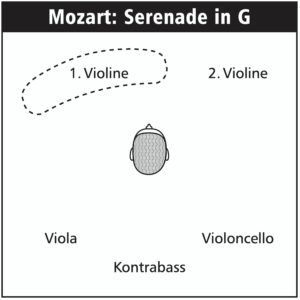
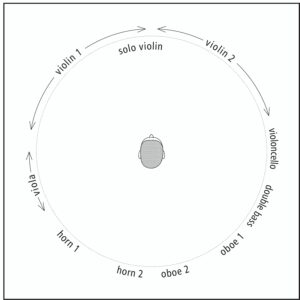
Thus, for instance, in this present recording, first and second violins are located about halfway down your listening space, and divided left and right across the sonic spectrum, so that you can hear the often very important (and witty) interchanges between firsts and seconds much more clearly than in “normal” 5.1, 5.0 or 4.0 recordings, or in stereo. Lower strings are placed slightly further towards the rear, woodwinds more towards the front speakers. The two horns (plus timpani) are well towards the front, the two trumpets well towards the rear, both divided left and right antiphonally. This type of arrangement is what TACET calls “Real Surround Sound”, in the sense, I guess, that the sound does really and genuinely surround you while you′re listening.
There are those who bridle at this kind of arrangement, dubbing it artificial or even gimmicky, and some of these critics have expressed their opinions forcefully elsewhere on this website. That′s fine (though I suspect that in several cases at least they have never actually listened to a TACET product). My own opinion is that what I hear on this disc is neither “artificial” nor “gimmicky”, but a beautifully integrated, uniquely transparent recording giving a special insight into the soundworld of these symphonies, how they work, the many interactions of instruments, and how they′re put together in the composing process.
I must stress that, despite the unprecedentedly high levels of detail available to the multichannel listener, the overwhelming effect of the recording is one of homogeneity and unity. There is assuredly much greater separation of instrumental strands and individual instruments than usual, but never at the expense of the overall sonic picture, which is unified and warmly enveloping, decidely not a collection of fascinating little titbits of spot-miked information patched together in a willy-nilly fashion. You are, as it were, “in media res”, but in no sense in an oppressive or intimidating fashion.
Quite the opposite – it′s a warmly enveloping and inviting sound-picture, one that uniquely facilitates active engagement with and reaction to the music. The interplay between the different string parts in the finale of Symphony 1, and the rousing call and response sequence between horns and trumpets in the powerful development section of Symphony 2′s opening movement, are but two examples among many of the special insights and enjoyments offered by TACET′s multichannel presentation of this music.
I′ll conclude by saying that I′ve never enjoyed these symphonies more, heard more of the subtleties of what is going on in them instrumentally, or had a more intimate insight into Beethoven′s creative thought processes in making them. Andreas Spreer is a uniquely imaginative, uniquely skilful “Tonmeister” who brings immense care and musicality to his recordings, and has already, in terms of the possibilities of multichannel sound for classical music, long since left the point at which most other companies have not yet even considered arriving.
I am confident that in due course of time Spreer will be hailed as one of the key innovators in sound recording history, and bracketed with the likes of Walter Legge, John Culshaw, and Wilma Cozart Fine as a member of that small, exclusive band of pioneers who have moved the classical recording industry forward in a genuinely new, exciting direction.
Terence Blain
Purchase not verified. Find out more